
Generations
What the pecans remember: harvest season on a Lake Hartwell estate
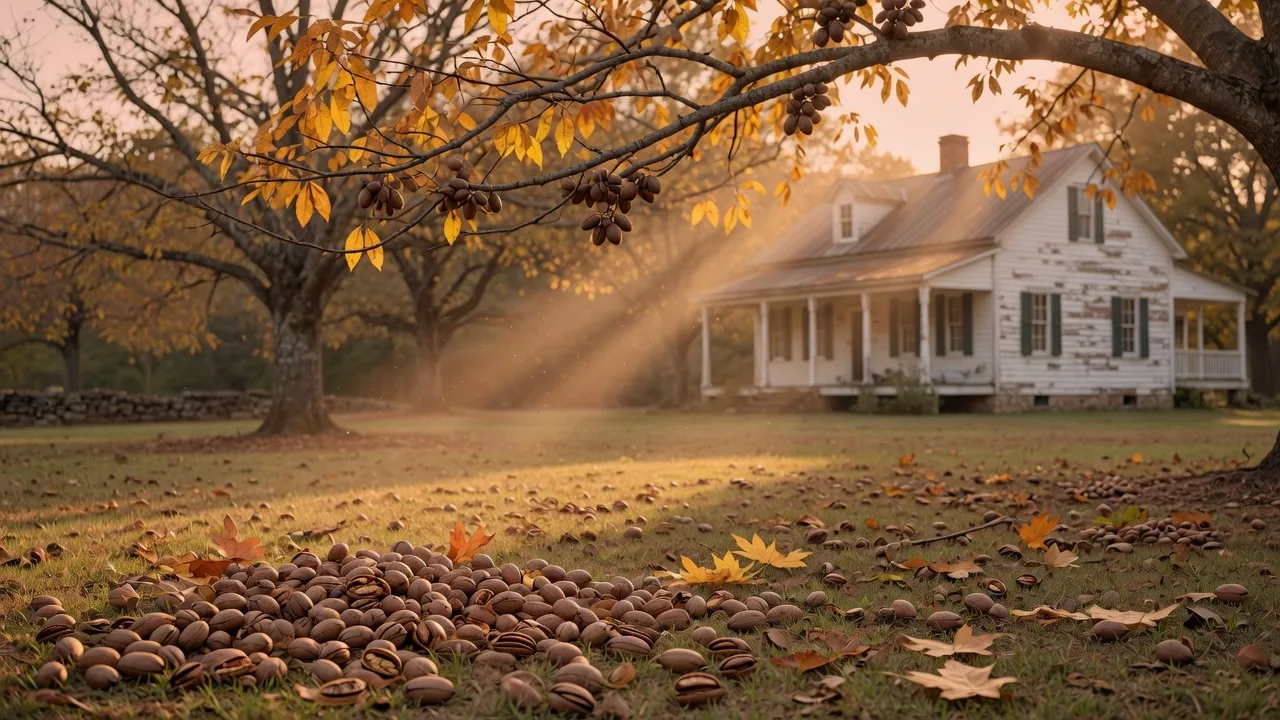
In November, when the lake crowds have gone and the water is at its quietest, the pecan grove at 257 Methodist Park Lane does what it has done every autumn for over a century and a half: it drops its harvest onto the lawn. The sound is distinctive — a soft, irregular patter like rain on leaves, except it isn't raining. It's pecans, falling from mature trees whose root systems reach deep into the Georgia clay, drawing up what this land has always offered to anyone patient enough to plant and wait.
Georgia's nut, this family's grove
Georgia has been the nation's top pecan producer for more than seventy years, growing roughly one-third of the country's supply across approximately 170,000 acres of commercial orchards. The state designated the pecan as its official crop in 1982, and the nut's history in Georgia stretches back to the 1800s, when settlers and Indigenous communities alike recognized the value of a tree that could produce 50 to 100 pounds of nuts per year for decades — even centuries — with minimal intervention.
But the commercial pecan farms of south Georgia — the flat, irrigated orchards that produce the bulk of the state's crop — are a different world from the grove at 257 Methodist Park Lane. These aren't row-planted cultivars optimized for mechanical harvesting. These are heritage trees — seedlings, not grafted — planted by hand in the 1870s and 1880s by a family that understood that a pecan tree is a long-term investment in food, shade, and the kind of landscape that only time can produce.
The trees are mature now — their canopies meeting overhead to create a continuous shaded corridor across the flat lawn. Their trunks are thick, their bark deeply furrowed, their root systems extending far beyond their drip lines into the deep clay subsoil that characterizes the Appalachian foothills of northeast Georgia. They've survived droughts, ice storms, the creation of a 56,000-acre reservoir, and a tornado that cleared the tree line to the north. They are still here, still producing, still dropping their harvest onto the same ground their original planters walked.
What harvest looks like
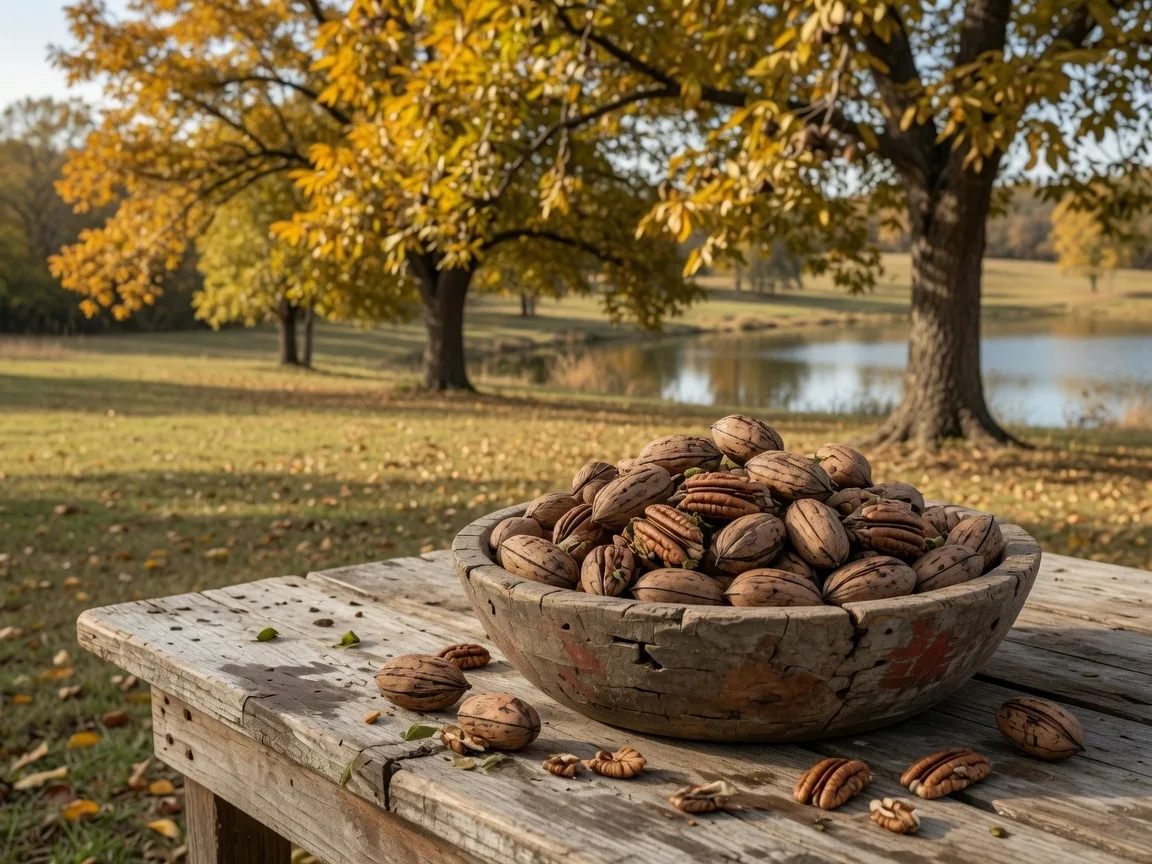
The pecan harvest on a property like 257 Methodist Park Lane isn't a commercial operation. It's a seasonal ritual — part work, part celebration, part communion with a landscape that has been producing food since before anyone alive can remember. It begins in late October, when the leaves start to yellow and the first nuts begin to drop. By mid-November, the harvest is in full swing.
The process is straightforward: you walk the lawn beneath the canopy, gathering what the trees have given. Some years are heavy — a mast year, when the trees coordinate their production and the ground is carpeted with nuts so thick you can barely see the grass. Other years are lighter, the trees resting after a strong season, conserving energy for the next cycle. A mature pecan tree produces in alternate years, with a heavy crop one year followed by a lighter one — a rhythm that the families who have harvested from these trees have learned to read and anticipate.
The pecans at 257 Methodist Park Lane are the native variety — not the paper-shell cultivars you find in grocery stores, but the thicker-shelled, richer-flavored nuts that pecan enthusiasts prize. Cracking them requires a hammer or a hand-cranked cracker, and the ratio of effort to reward is part of the appeal. The meat inside is dense, buttery, and sweet in a way that commercial pecans rarely match — because these nuts grew in deep, unworked soil, fed by root systems that have been mining minerals from the Georgia clay for over a century.
The shade that shaped the property
The pecan trees at 257 Methodist Park Lane weren't planted for harvest alone. They were planted for shade — and in a climate where summer temperatures regularly exceed 90°F, shade is infrastructure. The mature canopy provides hours of afternoon relief across the flat lawn, dropping the temperature ten to fifteen degrees beneath its branches. In the decades before air conditioning, this was the primary outdoor living space: the place where families ate, socialized, and escaped the Georgia sun.
Today, the shade serves the same function in a different context. When twenty people gather at the pavilion for a weekend lunch, the pecan grove is where the children play, where the hammocks hang, where the late-afternoon conversation migrates after the meal is done. The trees create rooms without walls — shaded clearings that feel distinct from the open lawn, each one defined by the reach of a particular canopy.
You cannot buy a hundred-year-old pecan grove. No landscape architect can design one. No budget can accelerate one. A pecan tree takes fifteen to twenty years to begin producing nuts and fifty to seventy years to reach full production. The grove at 257 Methodist Park Lane has been producing for over a century — and it will continue to produce for another century, long after every other element of this property has been renovated, updated, or replaced. The trees are the permanent feature. Everything else is negotiable.
The harvest as metaphor
There's a reason that families who own properties with mature pecan groves talk about the trees the way other people talk about heirlooms. The trees represent patience — the willingness to plant something you won't see mature, to maintain a landscape you won't fully benefit from, to invest in a future you can imagine but not guarantee. The family who planted these pecans in the 1870s didn't do it for themselves. They did it for the generation that would inherit the shade, the harvest, and the particular beauty of a grove that took a century to reach its full expression.
That generational thinking is embedded in every element of 257 Methodist Park Lane. The house was built to last, not to impress. The lawn was maintained for use, not for display. The pecan trees were planted for food and shade — practical investments that compound over decades. When the lake came in the 1960s and the landscape transformed around them, the trees remained what they had always been: the fixed point in a changing world.
For the next owner, the pecan harvest offers something that most luxury properties cannot: a direct, tangible connection to the land's agricultural past. You walk the lawn in November, gather what the trees provide, crack the shells, and eat the meat — and in that simple act, you participate in a tradition that predates the lake, predates the dam, and predates every modern amenity that surrounds you. The pecans don't care about the real estate market. They care about sunlight, water, and deep soil. And every November, they deliver.
The quiet season's gift
The harvest happens during what the lake community calls the quiet season — the months when the boats are stored, the marinas are empty, and the water belongs to the fishermen and the herons. For property owners who live in the rhythm of the lake, November is when the landscape reveals its other identity. It isn't a lakefront estate in November. It's a farm — a working piece of Georgia ground that produces food from trees that were planted by people who understood that the land's value isn't determined by what's fashionable but by what endures.
The pecan harvest is the quiet season's gift: a reminder that this property is more than waterfront. It's a living connection to the agricultural heritage of northeast Georgia — a heritage that the lake covered but didn't destroy. The trees remember. Every November, they prove it.
And when the harvest is done, when the last pecans have been gathered and cracked and eaten, the lawn is clear and the bare branches let the winter light reach the ground. The lake, visible through the now-transparent canopy, catches the low sun and holds it. The property enters its winter rest — but the trees, having given what they had to give, are already preparing for next year. They've been doing this for over 150 years. They'll be doing it long after we're gone.